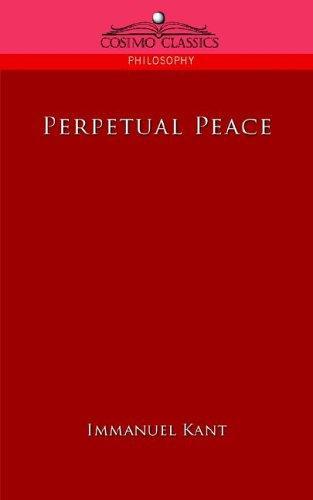
Between states... no punitive war is thinkable because between them a relation of superior and inferior does not exist. Whence it follows that a war of extermination, where the process of annihilation would strike both parties at once and all right as well, would bring out perpetual peace only in the great graveyard of the human race.-from "Perpetual Peace"One of the most influential thinkers of the Western civilization, a man who profoundly shaped the mind-set of the modern world, examines war and human nature and concludes, bracingly, that global peace is inevitable. Far from an unattainable utopian fantasy, this 1795 essay lays out the requirements for peace, including republican governments, freedom of movement for citizens, and-prophetically-the formation of a league of nations. In this era of imperialistic ambitions and preemptive wars, Kant's insight is a profound reminder that peace is possible but must be actively pursued.Also available from Cosimo Classics: Kant's Analytic of the Beautiful and Perpetual Peace.German metaphysician IMMANUEL KANT (1724-1804) served as a librarian of the Royal Library, a prestigious government position, and as a professor at K nigsberg University. His other works include Observations on the Feeling of the Beautiful and Sublime (1764), Critique of Pure Reason (1781), and Groundwork of the Metaphysics of Morals (1785).
A notebook of your own for this title
A blank page to write whatever you want, with images, spoilers and links to other titles.


Between states... no punitive war is thinkable because between them a relation of superior and inferior does not exist. Whence it follows that a war of extermination, where the process of annihilation would strike both parties at once and all right as well, would bring out perpetual peace only in the great graveyard of the human race.-from "Perpetual Peace"One of the most influential thinkers of the Western civilization, a man who profoundly shaped the mind-set of the modern world, examines war and human nature and concludes, bracingly, that global peace is inevitable. Far from an unattainable utopian fantasy, this 1795 essay lays out the requirements for peace, including republican governments, freedom of movement for citizens, and-prophetically-the formation of a league of nations. In this era of imperialistic ambitions and preemptive wars, Kant's insight is a profound reminder that peace is possible but must be actively pursued.Also available from Cosimo Classics: Kant's Analytic of the Beautiful and Perpetual Peace.German metaphysician IMMANUEL KANT (1724-1804) served as a librarian of the Royal Library, a prestigious government position, and as a professor at K nigsberg University. His other works include Observations on the Feeling of the Beautiful and Sublime (1764), Critique of Pure Reason (1781), and Groundwork of the Metaphysics of Morals (1785).
A notebook of your own for this title
A blank page to write whatever you want, with images, spoilers and links to other titles.
On the Common Saying “That may be correct in theory, but it is of no use in practice”Book · 179373 pages · Original title: Zum ewigen Frieden